Hi, I'm Lynette Farwell, daughter, carer, and creator of The Aged Care Transition Management System.

I have created this for the adult daughter or son carrying the aged care decision alone
Moving Mum Or Dad Into Aged Care Is Hard Enough.
Doing It Without Guilt, Chaos, And Family Conflict Shouldn’t Be Guesswork.
This is a calm, step-by-step system for adult children who know home may no longer be safe, but feel sick at the thought of breaking their parent’s heart.
If you are lying awake wondering whether you are doing the right thing, what to say, how to handle resistance, and how to stop your family from turning this into a war, this guide was made for you.
This is not another cold checklist.
It is a practical, compassionate system to help you move your parent into aged care with more calm, clearer conversations, and far less emotional damage.
This is made especially for adult children preparing for one of the hardest family decisions they may ever face.
You Know Something Has To Change...
But Every Option Feels Cruel.
Maybe Mum has fallen more than once.
Maybe Dad is forgetting meals, medication, appointments, or how to manage safely at home.
Maybe the doctor has hinted that more support is needed.
Maybe you have known for months that things cannot keep going like this, but every time you think about aged care, your stomach drops.
Because this is not just about choosing a facility.
It is about the look on your parent’s face when you say the words.
It is about the fear that they will think you are abandoning them.
It is about the brother or sister who has strong opinions but never shows up.
It is about trying to stay calm at work, with your kids, with your partner, while inside you feel like you are drowning.
And it is about the question that keeps coming back at 2am...
What if I get this wrong?
This Is For You If...
This is for you if you know your parent may no longer be safe at home, but you feel guilty even thinking about aged care.
It is for you if your parent says, “I’m fine,” but you can see the cracks.
It is for you if you are scared they will say, “You’re putting me away,” or “I’ll never forgive you.”
It is for you if your siblings have opinions, but the actual work keeps landing on you.
It is for you if you do not know what to say without crying, over-explaining, freezing, or making things worse.
It is for you if you want your parent to feel safe, respected, and loved, not discarded.
It is for you if you want to look back one day and know you handled this with dignity.
You do not need to be perfect through this.
You need a calm plan.
You Do Not Have To Figure This Out Alone
Get the step-by-step system for preparing emotionally, handling the conversations, managing family conflict, planning moving day, and supporting your parent through the first month.
I Thought The Hardest Part Would Be The Paperwork.
I Was Wrong.

When I helped my dad move into aged care, I thought the hardest part would be the forms, the phone calls, the packing, and choosing the right place.
It wasn’t.
The hardest part was the conversations.
The moment he looked at me and tried to convince me he was managing just fine.
The moment I heard the fear underneath his words.
The moment I realised this was not just a practical move. It was grief. For him. For me. For the life we both wished he could still have.
I remember thinking:
How do I do this without making him feel like I am giving up on him?
And that is the part nobody had prepared me for.
Not the government websites.
Not the glossy facility brochures.
Not the polite advice from people who had never sat in that chair.
What I needed was someone to say:
Here is what your parent is really feeling.
Here is why resistance does not mean they hate you.
Here is what to say when they are scared.
Here is how to manage your siblings.
Here is how to plan moving day without panic.
Here is how to walk out on that first day without feeling like you have abandoned the person who raised you.
That is why I created The Aged Care Transition Management System.
Not because this decision is easy.
Because it is too important to handle in crisis mode.
This Is Not Abandonment.
It Is Protection.
When you love your parent, aged care can feel like betrayal.
But sometimes love means facing the truth before a crisis forces your hand.
If your parent is falling, forgetting medication, becoming isolated, eating poorly, wandering, declining, or living with risks they can no longer manage, keeping everything the same is not always kindness.
Sometimes the loving thing is not pretending home is still safe.
Sometimes the loving thing is finding the right support before something worse happens.
That does not mean you will not feel guilty.
It does not mean your parent will never cry.
It does not mean every sibling will suddenly become helpful.
But it does mean you can move through this with more steadiness, more structure, and more compassion than you may feel capable of right now.
You are not trying to get rid of your parent.
You are trying to keep them safe, supported, and treated with dignity.
Most Aged Care Advice Talks About Paperwork.
This Talks About The Part That Breaks Your Heart.
Most advice tells you to compare facilities, gather documents, check fees, and organise the move.
Those things matter.
But they are not what keeps you awake at night.
What keeps you awake is:
What if Mum thinks I do not love her?
What if Dad refuses to go?
What if my sister says I am rushing it?
What if my brother disappears until the hard work is done, then criticises every decision?
What if I say the wrong thing and damage the relationship forever?
What if I walk out on moving day and completely fall apart?
That is why this system focuses on the emotional and family side of the transition, as well as the practical steps.
Because the move itself is hard.
But the guilt, resistance, family pressure, and uncertainty are what make it feel unbearable.
Introducing The Aged Care Transition Management System
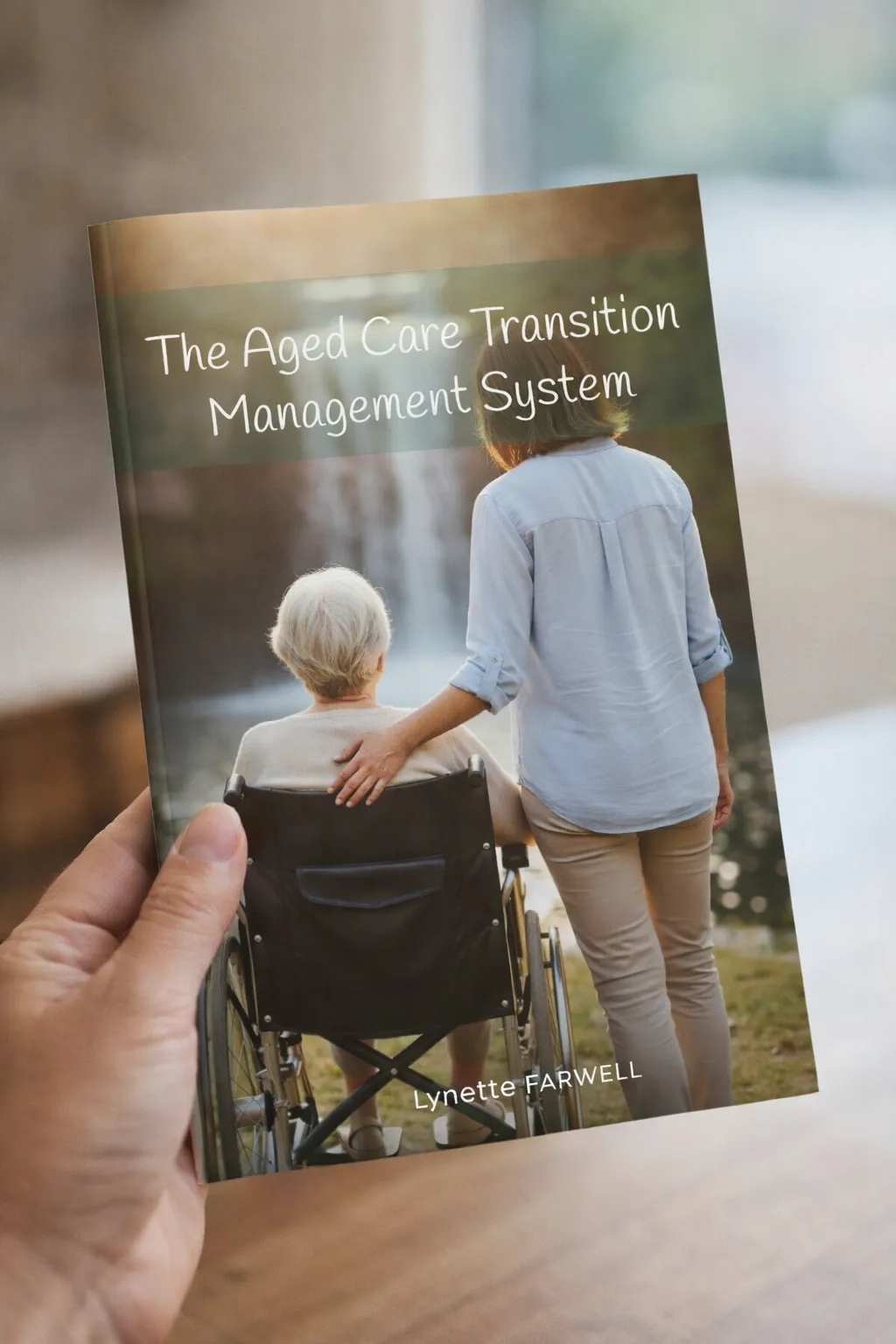
A compassionate step-by-step guide to moving your parent into aged care with love, dignity, and more peace than you thought possible.
This guide gives you a clear path through the emotional, practical, and family challenges of moving a parent into aged care.
Inside, you will learn how to prepare yourself, support your parent, handle resistance, reduce sibling conflict, plan moving day, and stay lovingly involved during the first month.
It is not legal advice.
It is not medical advice.
It is not financial advice.
It is the emotional and communication framework most families desperately need, but rarely receive.
Inside This Guide,
You Will Get:
A clear understanding of what your parent is really feeling
So you can stop hearing every resistant comment as rejection and start recognising the fear, grief, and loss underneath it.A gentle preparation plan
So you know what to do first, what to leave until later, and how to stop the whole process turning into last-minute panic.Word-for-word conversation guidance
So you are not standing there frozen when your parent says, “Please don’t make me leave,” “I’m fine at home,” or “You’re trying to get rid of me.”A family meeting framework
So siblings have clearer roles, fewer excuses, and less room to derail the process with blame, guilt, or last-minute opinions.A moving day plan
So the day itself feels calmer, more respectful, and less chaotic for everyone involved.First-month adjustment support
So you know what to watch for, how to stay involved, and how to help your parent feel safe, seen, and loved after the move.
The 6-Part Transition Framework
Part 1: Understand What Is Really Happening Emotionally
Learn why your parent may resist, deny, bargain, cry, withdraw, or lash out, and how to respond without escalating things.
Part 2: Manage Your Own Guilt And Anxiety
Learn how to quiet the 2am spiral, stop confusing guilt with failure, and remind yourself why this decision is being made from love.
Part 3: Prepare The Move Without Creating More Trauma
Use a calm preparation plan for conversations, tours, documents, downsizing, comfort items, room setup, and emotional closure.
Part 4: Talk To A Resistant Parent Without Making Them Feel Cornered
Learn how to lead with love, validate their feelings, and keep moving forward without turning every conversation into a battle.
Part 5: Handle Siblings And Family Conflict
Use a family meeting framework to reduce blame, define roles, and stop one person carrying everything while everyone else comments from the sidelines.
Part 6: Get Through Moving Day And The First Month
Know what to say, what to do, how to leave, how to visit, and how to stay involved without burning yourself out.
Start With The Next Calm Step
You do not have to solve the whole transition tonight. You just need a clear path and words you can trust.
This Is Not About Making Aged Care Feel Easy
I will not insult you by pretending this decision is simple.
It is not.
There may still be tears.
There may still be guilt.
Your parent may still resist.
Your siblings may still disappoint you.
But there is a big difference between a painful transition handled with care and a chaotic transition handled in panic.
This guide is here to help you slow things down, think clearly, speak gently, and protect the relationship as much as possible.
Not perfectly.
Lovingly.
Who This Guide Is For
This guide is for adult daughters, sons, daughters-in-law, sons-in-law, partners, and family carers who are preparing for residential aged care or seriously considering it.
It is especially for the person doing most of the emotional labour.
The one making the calls.
The one checking on Mum.
The one worrying about Dad.
The one trying to keep siblings informed.
The one carrying the guilt in silence.
The one everyone assumes will “just handle it.”
If that is you,
I wrote this with you in mind.
Who This Is
Not For
This is not for someone looking for legal, medical, or financial advice.
It is not a replacement for doctors, solicitors, financial advisers, aged care assessors, or qualified professionals.
It is not for someone who wants a cold checklist with no emotional guidance.
And it is not for someone looking to force a parent into care without compassion.
This is for families who want to do a hard thing as gently and respectfully as possible
Your Complete Starting Point
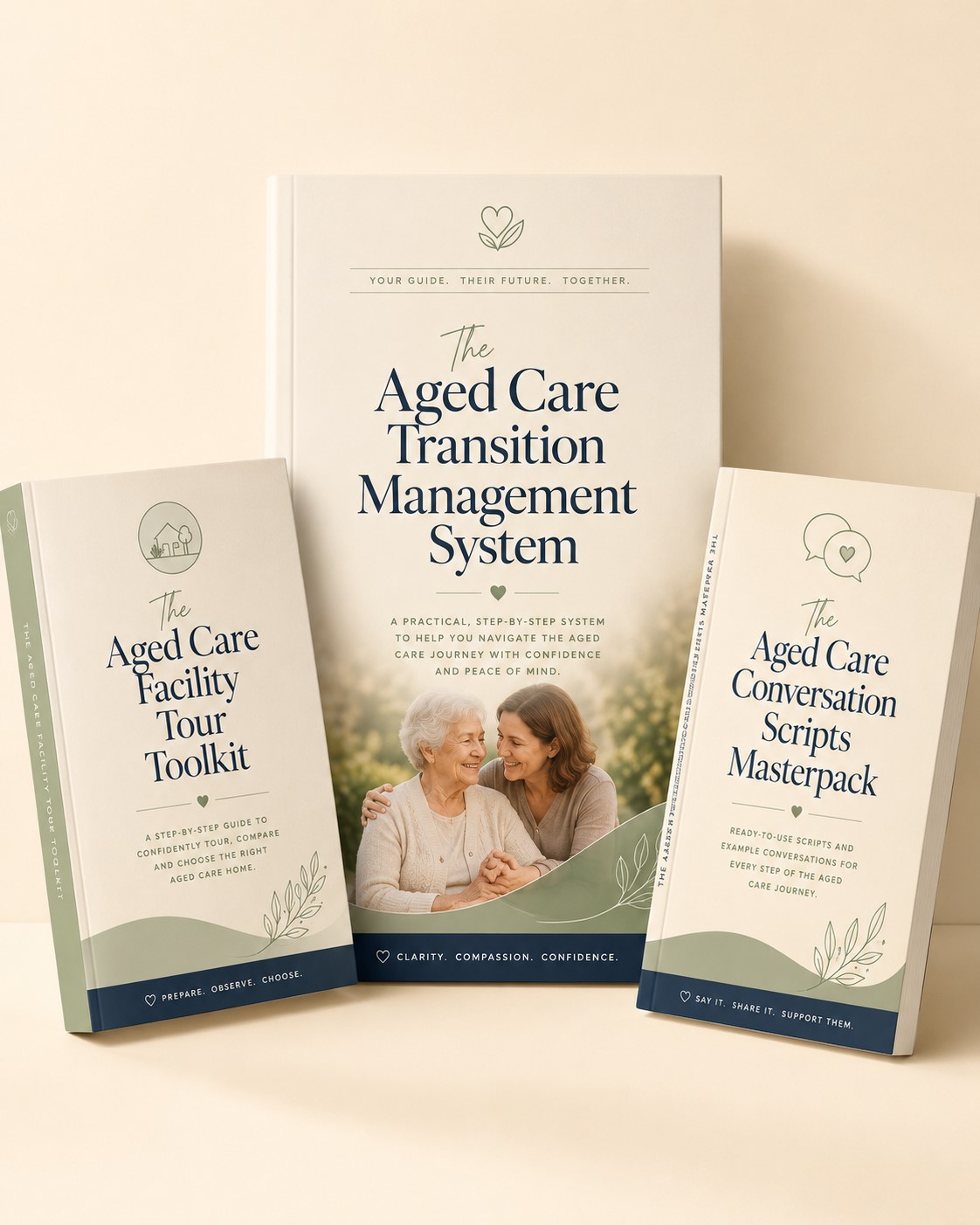
Main guide:
The Aged Care Transition Management System
The core roadmap for preparing emotionally, handling conversations, managing family conflict, planning moving day, and supporting your parent through the first month.
Optional checkout add-on:
The Aged Care Facility Tour Toolkit
A practical walk-through tool to help you compare facilities, ask the right questions, spot red flags, and trust more than polished brochures.
Optional upgrade:
The Aged Care Conversation Scripts Masterpack
A deeper collection of word-for-word scripts for resistant parents, emotional moments, siblings, facility staff, moving day, the first month, extended family, and your own guilt.
You can start with just the main guide today.
At checkout, you’ll also have the option to add extra support if you want help choosing a facility or handling difficult conversations.
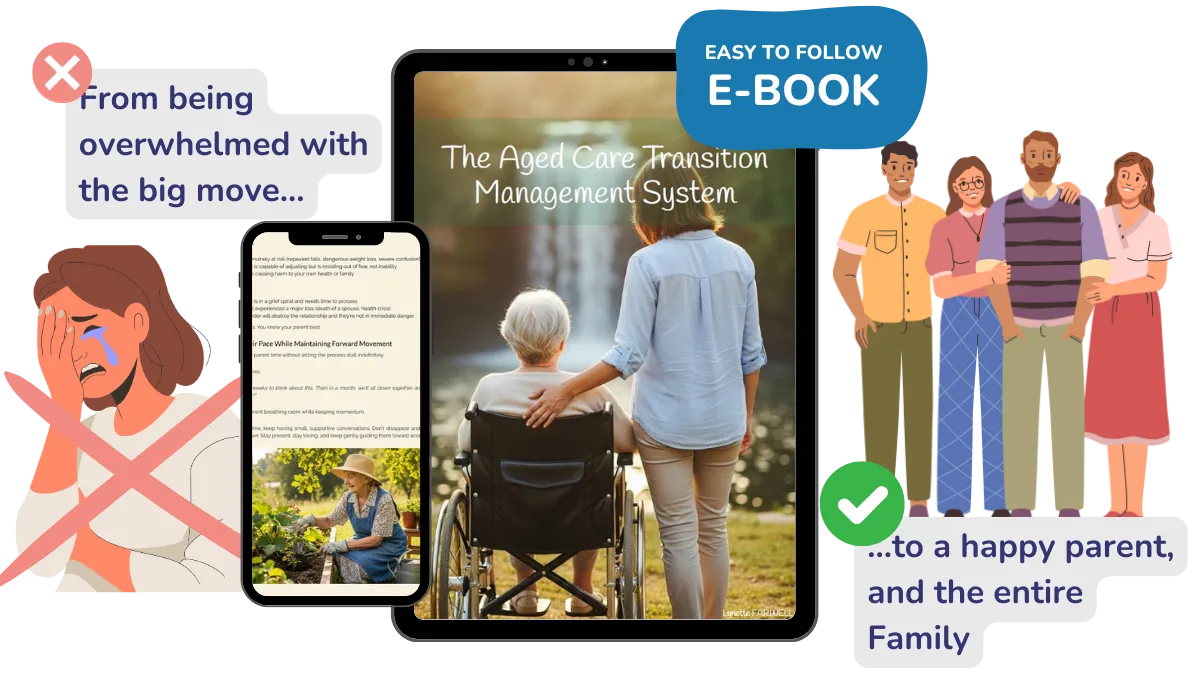
Get The Aged Care Transition Management System Today
You could keep searching government websites, saving random checklists, asking friends, and trying to piece together a plan while your stress keeps building.
Or you can start with a calm, compassionate system created for the part nobody talks about enough:
The guilt.
The conversations.
The family conflict.
The moving day grief.
The first month adjustment.
The fear of getting it wrong.
Today you get instant digital access to:
The Aged Care Transition Management System
Step-by-step transition guidance
Emotional preparation support
Conversation frameworks
Family meeting guidance
Moving day planning
First-month adjustment support.
A Gentle 30-Day Guarantee
I want this to feel like support, not pressure.
Read the guide. Use the first steps. See if it helps you feel clearer, calmer, and less alone.
If you genuinely feel it was not useful for your situation, contact us within 30 days and we will make it right.
No guilt. No drama.
You have enough of that already.
A Note From Lynette

I know this is not the kind of guide anyone dreams of needing.
Nobody wants to reach the point where aged care becomes part of the conversation.
But when that moment comes, you deserve more than cold instructions and vague advice.
You deserve someone to tell you the truth with compassion.
This is hard.
You may feel guilty.
Your parent may feel scared.
Your family may not handle it perfectly.
But you can still move through this with love.
You can still protect your parent’s dignity.
You can still make careful decisions.
You can still be a good daughter, son, or carer, even when the decision hurts.
That is what I want this guide to help you remember.
With warmth,
Lynette
You Are Not Failing Them.
You Are Trying To Protect Them.
Get the system that helps you prepare, speak, plan, and move forward with more calm and less guilt.
Questions You May Be Asking
What if my parent refuses to even talk about aged care?
That is exactly why the guide does not start with moving day logistics. It starts with emotional preparation, parent resistance, gradual conversations, and how to introduce the idea without making your parent feel cornered.
What if my siblings are the biggest problem?
There is a full family dynamics section to help you call a productive family meeting, define roles, reduce blame, and stop the process becoming one person doing all the work while everyone else criticises.
What if we have already chosen a facility?
The guide can still help. It covers downsizing, room setup, moving day, what to say during emotional moments, how to leave, how to stay involved, and how to support your parent through the first month.
Is this medical, legal, or financial advice?
No. This guide focuses on emotional support, communication, family dynamics, practical preparation, moving day, and adjustment. For medical, legal, or financial matters, please speak with qualified professionals.
Is this only for daughters?
No. It is written for any adult child or family carer. But it will especially resonate with the person carrying most of the emotional and practical load.
Will this make the transition painless?
No honest guide can promise that. This is a painful chapter. But the right preparation can reduce panic, confusion, guilt spirals, sibling conflict, and the feeling that you are making it up as you go.
How do I access it?
This is a digital guide. After purchase, you will receive an email with a link to access so you can start reading right away.
Sometimes the email will go to "junk" or "promotions" due to it containing a clickable link so please check in those folders if you don't receive the email within 3 minutes of checkout.
One Day, You Will Want To Know You Handled This With Love.
There may never be a perfect moment.
There may never be a conversation where everyone agrees.
There may never be a version of this where your heart does not hurt.
But there can be a calmer version.
A more prepared version.
A version where your parent feels heard.
A version where your siblings have clearer roles.
A version where moving day is handled with care.
A version where you are not walking through this blind.
And one day, when you look back, I want you to be able to say:

I did not abandon them.
I protected them.
I handled this with as much love and dignity as I could.